Monday, September 6, 2010

A Day in Back Bay

I've been in Boston for over two weeks now, and I haven't really written anything about it! Probably because the first week was the "be totally overwhelmed and confused" phase of moving, and the second week was the "spend five days at a conference and two days recovering" phase. (You mean you don't go through that phase when you move?) But now I'm starting to settle in, and yesterday for the first time I took public transport all by myself! I'm a big kid now! (People who grew up in real cities are probably laughing at me, but the extent of public transport in Jacksonville was a bus system that basically only gets you from one Walmart to the next, and a useless monorail that was built during the Every City Needs A Useless Monorail trend some years back, so I never took a city bus or train till I came to Boston.)

What was the big occasion that led me to venture into the city by myself? Church, yo. Specifically a 400-year-old church founded by this guy:


Yes, that John Winthrop. Which is amusing, given that it is a Unitarian-Universalist church now:


The inside of the church wasn't too remarkable, because part of it burned down in the '60s and had to be rebuilt, but the outside was way cool:


The service itself was lovely, something to do with Labor Day and the Walmart effect and what it means to do useful, fulfilling work - I'm not really a morning person so I'll admit a lot of it went over my head, but I got to hear a guy playing a harpsichord in person, and that is all that matters.

Back Bay is an upscale, historic neighborhood that's really pleasant to walk through, full of gorgeous old brownstones, brick sidewalks and cute little gardens.


After church I decided to wander over to the library and see if it's open on Sundays (it isn't), and on the way there I stopped at the Commonwealth Avenue mall. (Mall as in "long, narrow park", not "place where you drink an Orange Julius and wish you had money".)


One thing I like about Boston is there are statues everywhere, so whenever I go out I always come home with some names to Google. As a history geek, this pleases me.

William Lloyd Garrison, a damn cool guy who I hadn't heard of till I saw his statue


Not sure who this was, but he looks rather unfriendly.

My favorite thing was the Boston Women's Memorial, right in the middle of the park:

Remember the Ladies


I like Abigail's posture here. She's all like, "The Leggs of a Lady are none of your fucking Business, John."

Inscription on Lucy Stone's memorial

After the park, I walked over by the library and took some pictures there:

Old South Church

This entire building, including the bit hidden behind the tree, is the library. Oh baby.

I will DEFINITELY be coming back here.


This is the sign on a weird "city toilet" thing outside the library. You can't really see the text, but essentially it says that you insert a quarter, and the thing (which looks like some kind of alien space pod) opens up, and you get 20 minutes to desecrate it. After 20 minutes, the door automatically opens. So if you're anticipating a major colon blowout or something, find a real bathroom. There's also a lot of instructions on it about how to call 911 by pushing a button inside, which I thought was slightly ominous.

So, I'm digging Boston so far! Lots of cool historical shit, lots of cool people, lots of cool, uh, donuts - and it's gonna be fall soon! Yay!


Sunday, September 5, 2010

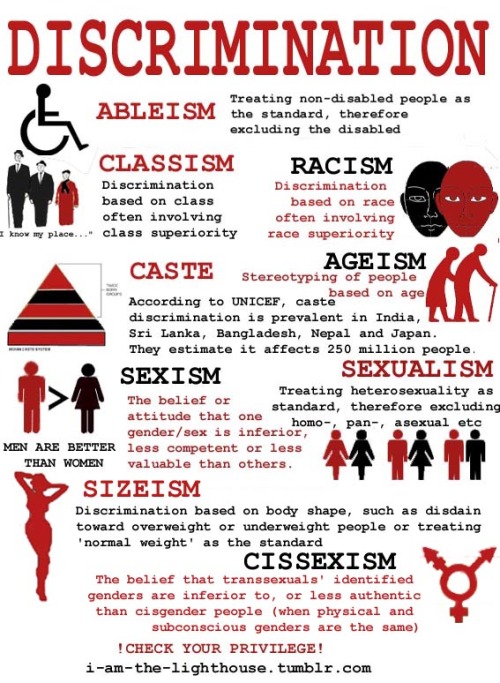
Don't Do It


To this I would add that discrimination absolutely does include "jokes" and those stupid things people "like" on Facebook. Just because you're kidding doesn't mean it doesn't hurt.

(Please note I am not necessarily endorsing all of the language choices the person who created the poster has made, but I do think it's a really fucking useful poster overall.)

Thursday, September 2, 2010

Leaving Narnia: What to do when someone comes out of the closet

At the Northeast Unschooling Conference this past weekend, my good friend Michael gave a talk, which he asked me to help with, on what to do when someone you love comes out of the closet. (The topic was Kathryn Baptista's idea, and a great one I think, so props to her for that!) For several reasons it ended up being a small group, which was fine, because that gave everyone who wanted to say something a chance to do so. But since I feel it's such an important topic, I wanted to write down some of the things we talked about and maybe some things we didn't get to talk about, for those who didn't get to be there.

I wanted to write that. The thing is, every time I sit down to write any kind of guide to what to do or what not to do, what comes out is this really long ungainly list of specific mistakes I've made, specific mistakes other people have made, specific things people did for me that were wonderful, specific things I did for others which went over well, etc. Accept asexuality as a valid sexual orientation. Don't say "fag" or "tranny" or "dyke". Don't ask people how they have sex. I quickly realized that if I were to make this anywhere close to comprehensive, it was going to take a year to read.

Then I caught myself. My list was becoming ungainly because I was making a list of rules. Generally, anytime a list of ways you should or shouldn't act gets to many, many items long, that's a red flag that you're approaching it from a mindset of rules rather than principles. Unschoolers tend to emphasize that the problem with rules is how constricting and frustrating they are, how they ignore the needs people are trying to express. But an even more fundamental problem with rules is that they simply cannot cover every situation that could come up. In the same way that "no hitting" still leaves you plenty of room to kick, bite, or verbally abuse, "don't ask people how they have sex" still leaves you plenty of room to ask what their genitals look like or ask their ex-partner how they have sex. Making rules, even ones designed to be adopted voluntarily, is a bit like cutting the head off a hydra. For every problem you address, several more spring up in its stead. If a guide is based on rules, there can be no workable abridged version.

So I took a step back from my list of rules and tried to find the principles behind them. Most of these could be broadened quite a bit more - "respect people" would just about cover it - but in order to show how they specifically apply to a person coming out of the closet, I've tried to find a middle ground between abstract principles and detailed examples. (This may still take a year to read, but it will be a much more helpful year *grin*).

1. Every person gets to define hirself. You know a guy who dated three women last year, but now says he's gay? He's gay. Your friend was a girly-girl in elementary school, but now identifies as a transgender man? He's a transgender man. Someone you met at a party says they're asexual, and all your biology training tells you that's a method of reproduction? Science be damned, it's a sexual orientation now. A person you know has come out as every sexual orientation under the sun, and you're not sure whether to believe them next time? Believe them anyway. Your friend has asked to be referred to using pronouns you could swear they (or ze, or xie, or sie) made up? Use them. Above all, trust that people know the insides of their own minds better than you do - even if their minds change over time.

2. Every person has a right to as much (or as little) privacy as they desire. Just because your friend is out to everyone you know doesn't mean ze's out to hir parents or coworkers. Just because your friend is extremely proud of being queer doesn't mean you should necessarily talk about it on the train or yell "homo" in a crowded theater. By the same token, I don't get to ask my friend to cover up his transgender tattoo because I'm uncomfortable having that conversation with someone who might see it. I don't get to forbid my daughter from telling grandma about her girlfriend. Disclosure is the queer person's choice to make, not yours.

3. LGBTetc. people are just people. If someone comes out to you, remember they were queer or trans before you knew, and they are still the same person now (though the coming out process may liberate or grow them in lots of ways). Knowing about a person's queerness need not change anything about your relationship with them (though your reaction may harm or strengthen the relationship). If you would never ask a question of a cis or straight person, don't ask it of a trans or queer person. Having a gay or trans friend is not a novelty or a symbol of how cool you are, anymore than having a redheaded or left-handed friend is. And remember that being queer or trans is only one aspect of who someone is. True, some people are "culturally lesbian" or "culturally trans" or whatever, and are way involved with queer stuff, but even then they are still individuals with their own habits, hobbies, interests and personalities, many of which will have not a damn thing to do with their gender or sexuality.

4. Everyone wants to feel safe. Unfortunately even in this day and age, lots of queer people, and particularly lots of trans people, do not feel safe in lots of situations, or only feel safe if their sexuality or gender identity is well-hidden. Anything you can do to make a person feel safe - whether you know them to be LGBTetc. or not - will be appreciated. This includes honoring their privacy as discussed above, but it also includes things like not tolerating homophobic or transphobic jokes, and avoiding heteronormative or cissexist language and assumptions (i.e., asking people when they're going to get married/have a baby, assuming your tomboyish friend would enjoy a free makeover, etc.) That last one takes practice, because certain assumptions are so deeply ingrained in Western culture, but the payoff in terms of the other person's comfort is well worth it, especially if the other person happens to be your child. Even if you can't change the mind of everyone you meet (and you can't), standing up for queer and trans people communicates to us that even if we're not safe with any of the other people in the room, we are safe with you. I am not exaggerating one bit when I say that there are people for whom having just one person who doesn't think they're sick or a sinner is the difference between life and death. Even if someone never comes out to you, just knowing you wouldn't condemn them if they did can quite literally save their life.

5. Everyone knows someone who is queer or trans. Michael's talk was somewhat ambiguously titled, and so lots of people came in the room, asked us what it was about, and politely but quickly left the room. I don't begrudge people one bit for choosing an activity more in line with their interests, but I also got a sense that many of these people's lack of interest in the topic came from a sense that this doesn't really apply to them. I can pretty well guarantee that unless you live in Upper Glennbeckistan, the topic of what to do when someone comes out absolutely applies to you. (And even if you do happen to live in Upper Glennbeckistan, the topic of what to do when someone is outed to the media by their former poolboy applies to you. Also, say hi to my family for me?) If you are a parent, this topic really really really applies to you. Even if your kid is two, because lots of people "feel different" from an extremely young age. The point is, no matter who you are, someone you know is not straight, or at least is questioning their sexual orientation. Someone you know is not cis, or at least is questioning their gender identity. If you wait till you know someone is not straight or not cis before you start thinking about how to accept them that way, you've waited too long. They already were who they are. I don't think it's ever too late to learn how to be kind to LGBTetc. people... but it's absolutely never, ever too early - especially, I will reiterate, if you have or are planning to have kids.

6. Every person has hir own story. I suppose this could be an addendum to #3, but I think it deserves a mention of its own. There are lots of wonderful books, movies and documentaries out there which tell the stories of queer and trans people. (There are also lots of not-so-wonderful ones, so watch out for that!) I would highly recommend the film Ma Vie En Rose and the book And the Band Played On, for example. But I would also caution anyone who seeks those out to realize they are not necessarily telling my story, or my friends' stories, or any of your friends' stories, or your kid's story. By the same token, your best friend's story, straight from the horse's mouth, is not my story, nor is my story hirs. True, another person's story may share elements with mine, and may give you a jumping-off point to understand my story. But the thing to remember is that knowing someone else's story does not mean that you know mine. Knowing how someone else feels doesn't mean you know how I feel. Accept that you don't know a queer or trans person's story until they tell it to you, just as you don't know a cis or straight person's story until they tell you.

7. People need people. Often, what an LGBTetc. person needs most is to be around other LGBTetc. people, but sometimes those who have just come out don't yet know where to find people like them. Here's a few of my personal favorite resources you could connect them with:

  • AVEN - Deals primarily with asexuality, but there's much discussion of sexuality in general, and their wiki has the most comprehensive information on gender identity I've found so far.
  • Scarleteen - Particularly for teens and young adults, but the advice is good for anyone.
  • Genderfork - An overall celebration of gender variance and gender rebellion.
  • Livejournal, which has many, many communities covering LGBT topics.
  • Books: Kate Bornstein's My Gender Workbook and Kimeron Hardin's The Gay and Lesbian Self-Esteem Book are good starting points. Do use caution, however, in giving people books, particularly people whose living situation may be jeopardized if a parent or roommate found a queer-themed book among their possessions.
  • PFLAG/TNET - You need support too, right? Plus, who doesn't love a PFLAG mom? You will get so many hugs.
  • And of course, any local LGBT community centers, support groups, pride festivals, or welcoming religious organizations (if they're interested in that) you can connect them with would be a huge help. (If you're in the Jacksonville, FL area, I've had wonderful experiences with JASMYN.)

Lastly and most importantly: If the person coming out to you is suicidal, do not attempt to save them all by yourself. Your support is undoubtedly important to them, but it is not fair to you, or to them, for you to be their only means of support. Let them know you're there for them and you love them unconditionally, but also try to move them in the direction of seeking help from those who have been trained to help them. This isn't just for your sake, but for theirs - if you don't know what you're doing, you may unintentionally make it worse, no matter how much you love them. One resource I've found extremely helpful is Metanoia's suicide page, which has probably saved my life more than once. In the United States, there are also several hotlines a person can call, such as the Hopeline (1-800-SUICIDE) (which also saved my life) and the National Suicide Prevention Lifeline (1-800-273-TALK). Finally, Metanoia's guide to helping a person who may be suicidal and their list of suicide warning signs are excellent. It would be a good idea in general to post some or all of these resources near your phone or computer so you can easily give them to someone in the event of a crisis.

I don't pretend that this list covers everything you could possibly need to know in order to deal with someone coming out. Every person is an individual, with individual needs. Every person has their own idea of what a perfect coming out would look like - some people will want you to sit and talk with them for a long time, others may prefer more of a "That's cool. Can you pass the salt?" response. Follow their lead. If they seem uncomfortable, think about what you could do differently. Ask them if they'd like to talk about it. Respect it if they'd rather not. Above all, know that even if you make mistakes, your support means the world to the person you love. Knowing that someone is at least trying to make me feel loved and safe will always make me feel more loved and safe than if they just didn't try at all.

Update: Even more trans-specific resources (thanks Michael!)

T-Vox (which lists many, many other resources)

I kind of wish I knew more gay and lesbian specific resources, because my interests and my immediate circle of friends tend to skew me heavily toward the transgender, bi/pan/queer, and asexual sides of things (which is a lot of sides of things, as it is! Phew!) So if anyone knows any really good resources for gay men and lesbians, please contact me and I will be happy to add those.

Tuesday, August 31, 2010

Will somebody invent a time-turner already?

I just got back last night from the 2010 Northeast Unschooling Conference. Because this is my favorite conference, I really want to say something about it, but I feel lost for words. Maybe that's because I haven't fully recovered from the lack of sleep and regular meals yet, or maybe it's because I just spent five solid days talking to a bunch of my favorite people and my words are all used up. Last year I came away with lots of new ideas and theories and navel-gazing things. This year, all I can offer is gratitude.

Things I'm really, really grateful for:

Kathryn, Beth, Julian, Jean, and everyone else who worked so hard on this thing to make it completely awesome, and were willing to give sleeping space and picnic transportation to lots of people.

Living thirty minutes, or an hour, or three hours, or eight hours away from people who I used to live no-fucking-way-in-hell far away from.

People who will happily give you a floor, a sandwich, or a ride most of the way home when you can't pay for any of them.

Early morning chats over accidentally-stolen coffee, and late night chats about stuff you just can't always mention in front of the sun.

Getting smiles and waves and hugs from people who were strangers until just moments ago.

Little kids who freely play, dance, express their feelings and their creativity, and go out of their way to find your watch and give it back to you when you drop it in the stairwell.

Friends who are willing to clean all the things, sing about bananas, make genetic waffles, pluck the still-beating hearts from squirrels*, shout about vajazzles and double dingos, find friends for Zombie Steve, and treat sandwiches like the serious business they are.

And lots and lots of other stuff! I won't say the conference was perfect, because nothing in life ever is. But it was sublime and supreme and lots of other superlative kinds of words, and listing every single thing I'm grateful for would take as long as recapping every minute of the conference. I think my only regret is that there wasn't nearly enough time to spend with everyone I wanted to see! The hardest part of a conference, besides saying goodbye, is being torn between wanting to spend as much time as possible with your closest friends, and wanting to make new ones. So until somebody gives me a time-turner so I can rewind and do multiple things at once, I'm gonna walk away from every conference with a little bit of regret for the things and the people I missed. But mostly, I'm just really fucking grateful to love and be loved by so many people that I can't see them all in five days.


*No actual squirrels were harmed in the course of this conference or the making of this blog post.

Saturday, August 14, 2010

(Not) Back to College

In less than a week, I will join thousands of other young adults in a traditional American ritual. I will cram my car full of as much crap as it will possibly hold, drive clear across the country to a place I have visited only once before, and move into a tiny room with another young adult. Sounds pretty familiar, right?

What makes my journey different is that I'm not going to college. The confluence of my transition with back-to-school time is a coincidence. I'm going, instead, to live in a pretty interesting neighborhood of Boston, with a friend and her family. And though this living situation will bear little actual similarity to college life, I think it's an interesting comparison. Because even though I won't have the curriculum of a formal program of study, the city has its own curriculum for me.

I will be studying:
  • Diversity, both ethnic (I will be staying with a Haitian family, in a neighborhood in which my friend says "you can walk down the street and hear five arguments in four different languages") and religious (Catholics and Muslims and Jews, oh my!)
  • Politics. I'll be going from a very conservative town to a very liberal one, which raises questions: What are the dynamics which make a city that is 40% Catholic also be 80% liberal? How do politics color the culture of a city? It'll be interesting to observe this stuff, especially with a major election around the bend.
  • History. Lots and lots and lots of history in Massachusetts. (Lots in Florida too, but the Massachusetts kind doesn't stir up so many icky feelings about my slaveholding ancestors, and is thus more enjoyable for me.)
  • Architecture. Nearly 50% of houses in Boston were built prior to 1939. Cool!
  • Weather. I've lived in Florida my whole life. 'Nuff said.
  • City Life. I am but a humble country mouse. Public transportation, knowing how to navigate on foot, personal safety - this stuff is new to me. Plus, I'll be exposed to all kinds of cool cultural stuff that Jacksonville, being more "America's most bloated suburb" than an actual city, does not have.
  • Diplomacy. I will be living in close quarters with a friend. That is always a learning experience in itself.

All of this is in addition to the things I will learn pursuing work and leisure, dealing with autism and chronic illness, and being a queer geek, just as I would anywhere else.

"Ah," say the naysayers, "but if you were going away to college in a new city, you'd learn all that plus a curriculum! So you're still missing out!" Oh, ye of little faith. First of all, I have lived on a college campus before, and I can say from experience that I am the sort of person who would simply cocoon myself up in campus life and never go exploring in the city. Second, anyone who knows me also knows that hellfire and dragons couldn't keep me from academic learning. I react to libraries the way Blanche Devereaux reacts to cheesecake. Third, if I were doing a formal full-time curriculum I would not have the time or inclination to sit and ponder about Catholicism and the Salem witch trials and the difference between sleet and freezing rain.

But most importantly, I will be learning about politics and history and diversity and architecture and the changing seasons because those are my interests. Those are the elements, in addition to friendship and good timing, that attracted me to a place like Boston in the first place. Were I not interested in those things, I probably wouldn't spend time thinking about them, and I may not have been excited to go to Boston in the first place. And none of those interests were sparked in me by any curriculum. Some of them were very nearly ruined by curricula, and even with the ones that weren't, I have never found a program of formal study that would satisfy my craving for them in just the right way. Going into a history program and studying whatever history they tell you to study, when your passion is for a specific aspect or period of history, is quite like going into a bakery and ordering a slice of lemon meringue pie when you were craving chocolate cake. You're in the right ballpark, but man, when you need chocolate cake, nothing else will do. You just can't enjoy that lemon pie like you would if you'd really been wanting it. Learning is very much the same.

So I'm gaining a lot of benefits I wouldn't necessarily have in college. As for what I'm missing? Let's see... there's the thousands of dollars worth of debt, the experience of living with a complete stranger who might steal your stuff or have sex on your bed, the pressure to join a sorority, the bad cafeteria food, the feeling of being babysat all the time despite being a legal adult... Oh yeah, and the Almighty Piece of Paper. Fine. If I decide I want one of those, I can get it. But for now, all the other benefits of college are coming to me, at far less cost, and in ways that are not artificially constructed by people who have never met me, yet claim to know what I need. Sounds like a good deal to me.

Friday, August 13, 2010

Why I am a socially awkward geek

STAGES OF SOCIALLY AWKWARD CONVERSATION

Stage One: Excited Yammering

"Hi I heard you like Mudkips!"
"OMG I LOVE MUDKIPS! They're so like, blue!"
"Yes! And water Pokemon are the best!"
"I love Lapras!
"Yes! Lapras!"

Stage Two: Running Out of Steam

"So, um, I had a sandwich today..."
"Oh, cool. What kind?"
"BLT."
"Nice."

Stage Three: Person Says Thing Which Most People Would Have No Problem Responding To But I Have No Idea What in The Hell to Say

"There's a great sandwich place near my house."
"...cool"

Stage Four: Awkward Silence

[agonizing 30-second pause which seems more like 30 minutes and I am wondering if the other person hates me now because I didn't engage their sandwich thing, and now I'm not sure where to put my eyes so I end up staring into space and looking like I am about to start drooling and then I suddenly realize that and I get all self-conscious and stare at my shoes instead]


Next is the stage which is sometimes referred to as "repairing a conversation". This is the stage people with Asperger's are notoriously bad at. I am no exception.

Stage Five: Desperate Attempt to Salvage Conversation by Blurting Out Whatever is in My Head

"Did you know James Buchanan was probably gay? He was the president right before Lincoln. Some people think Lincoln was gay too because he shared beds with other men, but he probably just couldn't afford a bed. Also he had syphilis. But everybody had syphilis back then."
"...heh."

Stage Six: Panic Over Other Person's Lukewarm Response Coupled With Even More Desperate Attempt to Pull Conversation Back to Common Ground

"So anyway! Mudkips! Yes!"
"Mudkips are cool."
"Yeah."
"One time I caught a Mudkip and named it Fart."
"Hehe. Fart."
"Yeah."

And that's where the conversation usually dies its final, painful death. This is why I have learned to associate a) mainly online, and b) mainly with other socially awkward people, because those conversations go more like this:

Person 1: Remember Thundercats?
Person 2: I never watched Thundercats. I liked TMNT a lot though. And Captain Planet. Everyone says Heart is a sucky power but I think being able to command whole herds of buffalo to do your bidding would be pretty badass.
Person 3: Hey guys I made spaghetti
Person 4: [randomly quotes Cracked article]
Person 5: OH MY GOD I HAVE TO POOP SO BAD BRB
Person 2: [still yammering about 80s cartoons]
Person 3: This spaghetti sauce coulda been better, I don't think I used enough oregano
Person 1: Man I usually just use sauce from a jar
Person 4: [still quoting from Cracked]
Person 5: The poop, it was HORRIBLE!
Person 2: Nice


I made that transcript up, but just barely. It probably sounds like a horrible trainwreck to anyone with a remotely organized brain, but it is normal conversation for me. So if you ever try to engage me in conversation, and I end up staring blankly into space, it's not because I'm not listening. It's because I'm trying to think of a response that is appropriate and doesn't involve poop or Thundercats or randomly blurting out something about gay dead people or things I see out of the corner of my eye. This can take me an alarmingly long time, because I have to sift through all the contents of my brain like an unsorted toy box. The socially-appropriate response is in there, but it's usually underneath many piles of plastic dinosaurs, and often by the time I find it, enough time has passed that the response is no longer socially appropriate:

"I bought new shoes today!"
[almost a full minute passes as I sift through possible responses: I wear shoes too, I haven't bought new shoes in like five years, remember light-up sneakers?, non-sequitur Simpsons quote involving shoes, dude remember Thundercats, cool what kind of shoes... yes! That one!]
"Cool, what kind of shoes?"

But by then it is too late. I have already been staring into space, looking puzzled, for a full minute, and the other person has either wandered off or has begun to wonder if I am experiencing some kind of temporal lobe seizure. Or they just think I am retarded. Usually that one.

This is compounded by the fact that I frequently cannot decode what a person has actually said until several seconds after they say it. My actual hearing is fine, but someone has clogged my ear-to-brain tubes with their internet porn, or something, because the words get stuck on the way there:

What you say: Do you want a sandwich?
What I hear: Djoowamma sawitch?
My response: [30 seconds of unresponsive staring in which it does not occur to me to go "What?"]
My brain process: Someone is making noise with their mouth. They are talking. Are they talking to me? They are looking at me. Shit. What did they say? Dew in the subway? Jew on the sub-witch? No! Do you want... do I want what? Person is holding a sandwich. Do I want a sandwich!
Me, feeling as if I have won a gameshow: Yes! I'll take a sandwich!! :D

This is if I am lucky enough to be continuously in the same room as the person talking to me. If they say something as I am walking by, I may never respond. This is why I hate it when store employees say hello to me. By the time I realize a person has spoken to me, and figure out what they said, and figured out how to respond, they have long since walked by, and I look like a big fat jerk.

So if you ever meet someone who appears to be an idiot, it is quite possible they are experiencing some kind of mental process like I have outlined above. Or maybe they are a self-absorbed ass. There's really no way to tell. It may not be exactly reassuring to know there is no way to immediately discern whether someone is an asshole or just experiencing some kind of cognitive dysfunction, but um, yay neuroscience?

Yay.


*It occurred to me on rereading this post that I made it seem like I really, really like Thundercats, and now probably everybody at NEUC is gonna come up to me and be like "So! I heard you like Thundercats!" and then I will have to explain that I've never seen Thundercats in my life and it's just sort of a meme for people who were kids in the 80s to be like "omg remember THUNDERCATS?" except most of the people who read my blog weren't born in the 80s and wouldn't get that which means they also wouldn't try to talk to me about Thundercats anyway so I don't know why I even brought it up. And now I've said Thundercats like 75 times in this post and I will probably get an inordinate amount of blog hits from people looking for information about cheesy 80s cartoons and actually my blog is mostly about navel-gazing and they will be sad.

Sunday, August 8, 2010

Accounting for Taste

I was thinking about South Park today. Well, more to the point, I was thinking of a comment left on this entry from The Seventeen Magazine Project, a brilliant project undertaken by an equally brilliant teenager. The comment in question, or the part of the comment that got me thinking, was this:

"this is exactly why i hate southpark. i don't need a bunch of straight white males telling ME what i should and shouldn't find offensive, thanks."

The discussion wasn't about South Park at all, and the mention of it was somewhat incongruous to the rest of the thread, but I still found it relevant. Now, for those of you who don't watch South Park, I realize it looks like a crude, potty-humor cartoon suitable mainly for stoners. When it first came out (half my life ago - ouch), that's basically what it was, and I'll admit there's still that element to it. But over the years, it has also developed into a forum for biting political and social commentary. What interested me about this comment is that it points out the privileged viewpoint from which Trey Parker, Matt Stone, and many of the other South Park writers make their arguments. Indeed, the episodes sometimes espouse the kind of views that would make me switch off the TV in disgust if they came from the mouth of a serious political pundit. And yet, I love South Park, even when it offends me. Why?

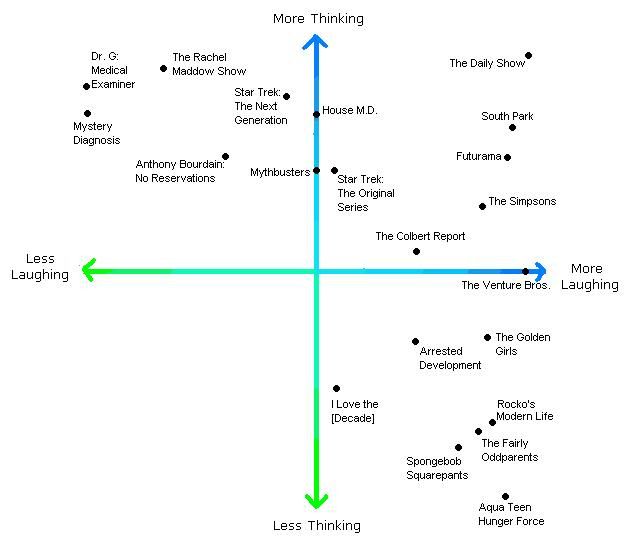
I spent some time today mulling that over, and I realized that it basically comes down to this: Regardless of whether South Park makes me shake my head in disgust or clap wildly in agreement (and it seems to do both in equal shares), it is one of the very few shows that both makes me laugh and makes me think on a consistent basis. Thinking on that more, I realized essentially every show I watch is appealing for one or both of those reasons. I've been feeling a bit data-happy lately, so I decided to make a graph. Below is a plot of 21 shows I watch regularly, or watched regularly in the past, and my reasons for watching. (I was tempted to knock one off to make a nice round number, but a mother cannot choose between her children.)


(Click to embiggen.)

A few notes on this graph. First of all, this is obviously completely subjective. I can only rank how much a show makes me laugh or think; there is no objective measure of how funny or thought-provoking a show is. Which brings me to my next point: The shows which make me think the most are not necessarily "smarter" shows. I would rate Arrested Development, for example, as a "smarter" show than South Park, in terms of the humor being much more sophisticated. But South Park got a higher "think" score because it generally makes me question my views or reflect on things that are going on in the world. Arrested Development simply puts its smarts in a different basket.

I also feel like shows intended for children got shafted a bit because of my age. As a near-25-year-old, Rocko's Modern Life doesn't really inspire a lot of original thought in me, but when I was seven - and thus part of its primary target audience - it certainly did, and were I seven years old today, I'm sure Spongebob and The Fairly Oddparents would as well. So again, there is really no way to measure a show's ability to provoke thought.

The biggest thing I noticed, however, is that even ranking the shows as honestly as possible, not a single one fell into quadrant III. Nothing. Zilch. There are definitely shows I would put in that quadrant, I just don't personally watch any of them. But someone does, or they wouldn't last a minute on the air. So while "makes me laugh" and "makes me think" are my personal criteria, it occurs to me that other people may have completely different reasons for enjoying or not enjoying a show. Of course, it's probable that shows that I would put in quadrant III would be in another quadrant for somebody else. But I still suspect that other people's reasons for watching a show are not the same as mine. For example, there's a long list of things I don't really care about in a show:

  • The cinematography
  • The quality of the acting (I like William Shatner, for God's sake)
  • High drama/action/badassery
  • Fashion, style, and trendiness
  • Sex and romance
  • The hotness of the cast (Except for Hugh Laurie. And Rachel Maddow. And Leonard Nimoy*. And Jon Stewart. Okay, fine, so maybe this helps a little.**)

Those things can make a show better, mind you, but they're not going to draw me in to begin with; they're icing on the cake of shows I already like. But I recognize that for some people, these factors may be much more important, to the point of making or breaking a show entirely.

So tell me, internets, what do you look for in a show? I've put a poll on the sidebar of my blog, and would really appreciate your responses. I'd also love to hear your thoughts in the comments, especially if there is some factor I've left out of the poll. I think this stuff is interesting to think about, not only because it can help us understand our own preferences, but it can also help build bridges between our own interests and those of other people. It's much easier to find the value in what another person likes if you're aware of all the different ways a show can be appealing, and that can go a long way to prevent shaming and judgement over differences in taste - something that, I must admit, I am still working on.


*Do not question this. I will sic all of my Trekkie friends on you. It won't be pretty.

**Although I still maintain that there is a clear difference between smart-people hot and Hollywood-pretty hot. I would not find these people one bit attractive if they did not make me laugh and/or think, so I maintain that I have not actually diverged from my basic point here. Much.